设置规则的Webhook通知。
当您在自动化操作中添加 Webhook URL 后,只要您定义的规则与任何新运行匹配,我们将向您的 Webhook 端点发起 POST 请求。
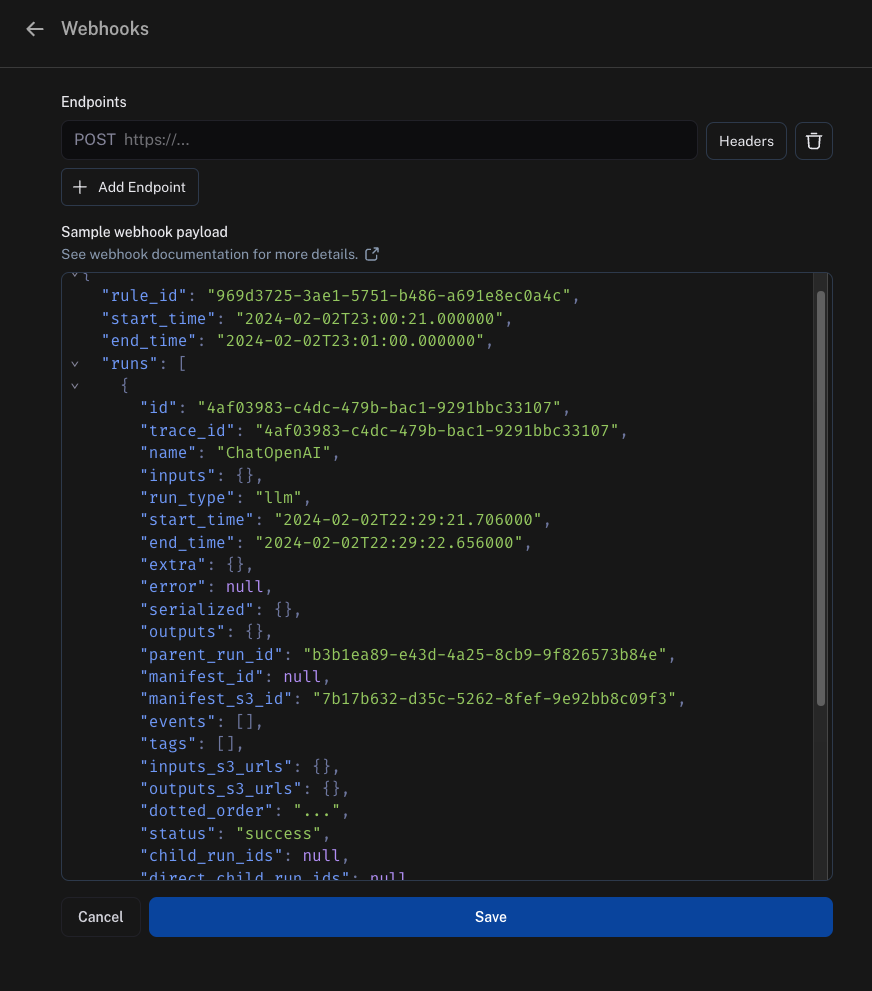
Webhook 有效载荷
我们发送到您的网络钩子端点的有效载荷包含
"rule_id"这是发送此有效载荷的自动化任务的ID"start_time"和"end_time"是我们找到匹配运行的时间边界"runs"这是一个运行记录数组,其中每个运行记录均为一个字典。如需获取每个运行记录的更多详细信息,我们建议您在端点中使用我们的SDK,通过API来获取。"feedback_stats"这是一个包含各次运行反馈统计信息的字典。该字段的示例有效载荷如下所示。
"feedback_stats": {
    "about_langchain": {
        "n": 1,
        "avg": 0.0,
        "show_feedback_arrow": true,
        "values": {}
    },
    "category": {
        "n": 0,
        "avg": null,
        "show_feedback_arrow": true,
        "values": {
            "CONCEPTUAL": 1
        }
    },
    "user_score": {
        "n": 2,
        "avg": 0.0,
        "show_feedback_arrow": false,
        "values": {}
    },
    "vagueness": {
        "n": 1,
        "avg": 0.0,
        "show_feedback_arrow": true,
        "values": {}
    }
},
根据您运行时间的远近,inputs_s3_urls 和 outputs_s3_urls 字段可能包含指向实际数据的 S3 URL,而非数据本身。
inputs 和 outputs 可分别通过 inputs_s3_urls 和 outputs_s3_urls 中提供的 ROOT.presigned_url 获取。
这是我们发送到您的网络钩子(Webhook)端点的完整有效载荷示例:
{
  "rule_id": "d75d7417-0c57-4655-88fe-1db3cda3a47a",
  "start_time": "2024-04-05T01:28:54.734491+00:00",
  "end_time": "2024-04-05T01:28:56.492563+00:00",
  "runs": [
    {
      "status": "success",
      "is_root": true,
      "trace_id": "6ab80f10-d79c-4fa2-b441-922ed6feb630",
      "dotted_order": "20230505T051324571809Z6ab80f10-d79c-4fa2-b441-922ed6feb630",
      "run_type": "tool",
      "modified_at": "2024-04-05T01:28:54.145062",
      "tenant_id": "2ebda79f-2946-4491-a9ad-d642f49e0815",
      "end_time": "2024-04-05T01:28:54.085649",
      "name": "Search",
      "start_time": "2024-04-05T01:28:54.085646",
      "id": "6ab80f10-d79c-4fa2-b441-922ed6feb630",
      "session_id": "6a3be6a2-9a8c-4fc8-b4c6-a8983b286cc5",
      "parent_run_ids": [],
      "child_run_ids": null,
      "direct_child_run_ids": null,
      "total_tokens": 0,
      "completion_tokens": 0,
      "prompt_tokens": 0,
      "total_cost": null,
      "completion_cost": null,
      "prompt_cost": null,
      "first_token_time": null,
      "app_path": "/o/2ebda79f-2946-4491-a9ad-d642f49e0815/projects/p/6a3be6a2-9a8c-4fc8-b4c6-a8983b286cc5/r/6ab80f10-d79c-4fa2-b441-922ed6feb630?trace_id=6ab80f10-d79c-4fa2-b441-922ed6feb630&start_time=2023-05-05T05:13:24.571809",
      "in_dataset": false,
      "last_queued_at": null,
      "inputs": null,
      "inputs_s3_urls": null,
      "outputs": null,
      "outputs_s3_urls": null,
      "extra": null,
      "events": null,
      "feedback_stats": null,
      "serialized": null,
      "share_token": null
    }
  ]
}
Webhook 安全性
我们强烈建议您为 Webhook URL 添加一个密钥查询字符串参数,并在处理任何传入请求时验证该参数。这样,即使有人发现了您的 Webhook URL,您也能将那些调用与真实的 Webhook 通知区分开来。
例如
https://api.example.com/langsmith_webhook?secret=38ee77617c3a489ab6e871fbeb2ec87d
Webhook 自定义 HTTP 请求头
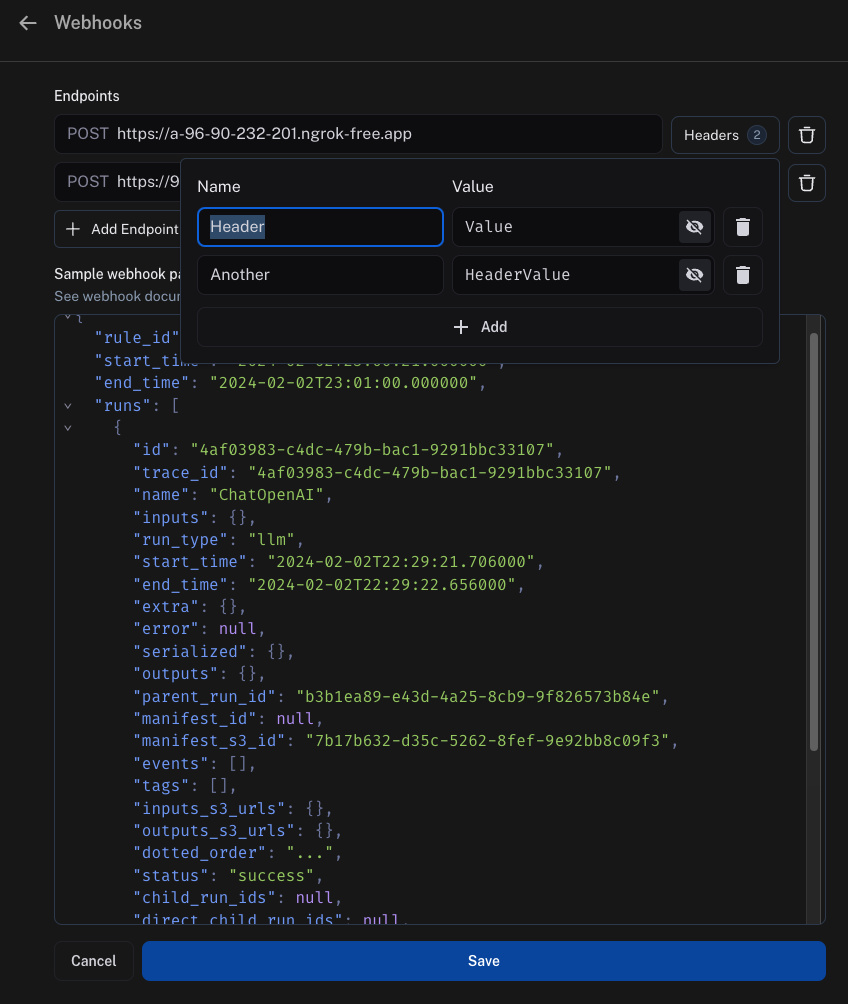
如果您希望为网络钩子(webhook)发送特定的请求头,可以针对每个 URL 单独配置。要进行此设置,请点击 URL 输入框旁的 Headers 选项,然后添加您的请求头。
标头以加密格式存储。
Webhook 交付
向您的 Webhook 端点发送事件时,我们遵循以下准则
- 如果我们无法连接到您的端点,将在声明投递失败之前,最多重试传输连接 2 次。
- 如果您的端点响应时间超过 5 秒,我们将判定投递失败,且不会执行后续操作。
- 如果您的端点在 5 秒内返回 5xx 状态码,我们将最多重试 2 次,并采用指数退避策略。
- 如果您的端点返回 4xx 状态码,我们将声明投递失败且不进行重试。
- 端点在响应体中返回的任何内容都将被忽略
带模态框的示例
设置
以 Modal 为例来说明如何进行设置。Modal 提供了用于推理和微调的自动扩缩 GPU、用于代码智能体的安全容器化环境,以及无服务器 Python Web 端点。本文将重点介绍 Web 端点。
首先,创建一个 Modal 账户。然后,在本地安装 Modal SDK:
pip install modal
要完成账户设置,请运行以下命令:
modal setup
并遵循说明
密钥
接下来,您需要在 Modal 中设置一些密钥。
首先,LangSmith 需要通过传入一个密钥来向 Modal 进行身份验证。
最简单的方法是在查询参数中传入该密钥。
为验证此密钥,我们需要在 Modal 中添加一个密钥以完成校验。
我们将通过创建一个 Modal 密钥来实现这一点。
您可在此处查看有关密钥的说明:此处。
为此,我们将密钥命名为 ls-webhook,并将其设置为一个环境变量,变量名称为 LS_WEBHOOK。
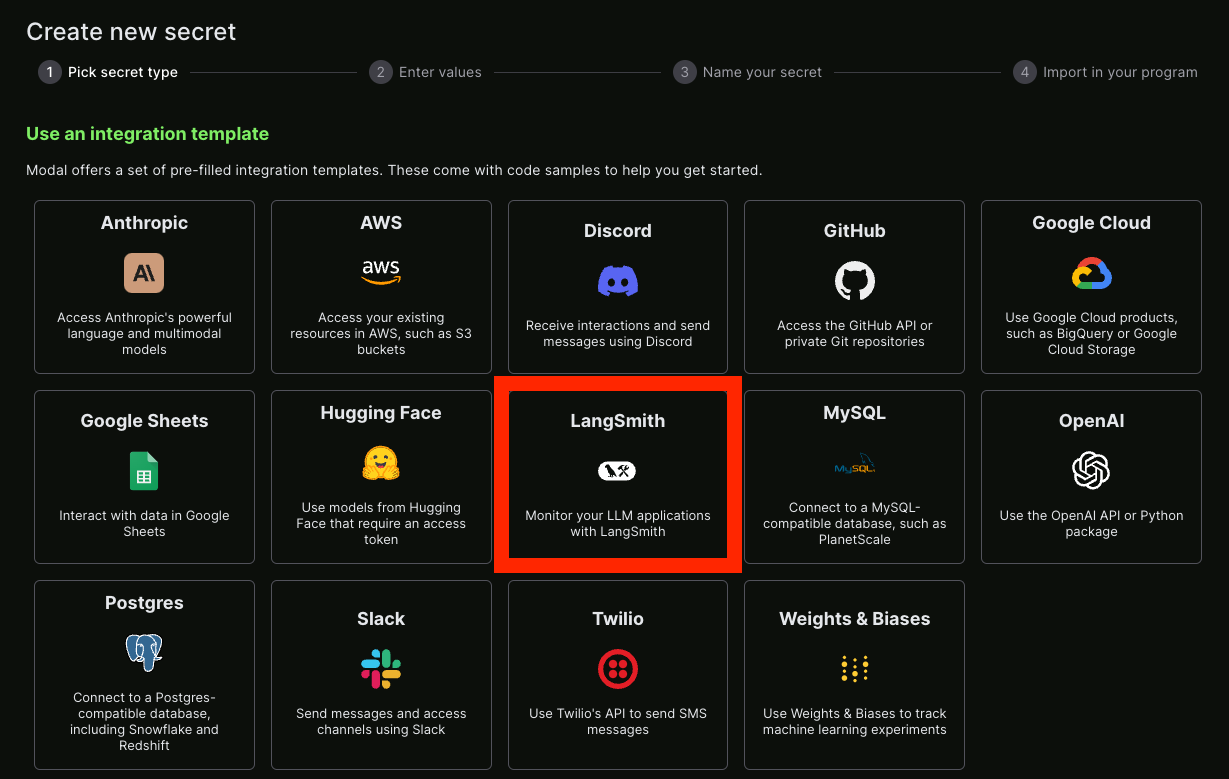
我们还可以设置一个 LangSmith 密钥——幸运的是,目前已有现成的集成模板!
服务
之后,你可以创建一个 Python 文件,该文件将作为你的端点。 以下是一个示例,其中包含注释,用于解释各部分的作用:
from fastapi import HTTPException, status, Request, Query
from modal import Secret, Stub, web_endpoint, Image

stub = Stub("auth-example", image=Image.debian_slim().pip_install("langsmith"))


@stub.function(
    secrets=[Secret.from_name("ls-webhook"), Secret.from_name("my-langsmith-secret")]
)
# We want this to be a `POST` endpoint since we will post data here
@web_endpoint(method="POST")
# We set up a `secret` query parameter
def f(data: dict, secret: str = Query(...)):
    # You can import dependencies you don't have locally inside Modal functions
    from langsmith import Client

    # First, we validate the secret key we pass
    import os

    if secret != os.environ["LS_WEBHOOK"]:
        raise HTTPException(
            status_code=status.HTTP_401_UNAUTHORIZED,
            detail="Incorrect bearer token",
            headers={"WWW-Authenticate": "Bearer"},
        )

    # This is where we put the logic for what should happen inside this webhook
    ls_client = Client()
    runs = data["runs"]
    ids = [r["id"] for r in runs]
    feedback = list(ls_client.list_feedback(run_ids=ids))
    for r, f in zip(runs, feedback):
        try:
            ls_client.create_example(
                inputs=r["inputs"],
                outputs={"output": f.correction},
                dataset_name="classifier-github-issues",
            )
        except Exception:
            raise ValueError(f"{r} and {f}")
    # Function body
    return "success!"
现在,我们可以使用 modal deploy ... 轻松部署此应用(参见此处的文档)。
你现在应该会看到类似以下的内容:
✓ Created objects.
├── 🔨 Created mount /Users/harrisonchase/workplace/langsmith-docs/example-webhook.py
├── 🔨 Created mount PythonPackage:langsmith
└── 🔨 Created f => https://hwchase17--auth-example-f.modal.run
✓ App deployed! 🎉

View Deployment: https://modal.com/apps/hwchase17/auth-example
需要牢记的重要一点是 https://hwchase17--auth-example-f.modal.run —— 我们创建的用于运行的函数。
注意:此地址并非最终部署 URL,请务必避免误用。
集成它
现在,我们可以使用上面创建的函数 URL,并将其添加为 Webhook。 我们还需记住,要将密钥作为查询参数一同传入。 将所有内容整合起来,其形式应类似于:
https://hwchase17--auth-example-f-dev.modal.run?secret={SECRET}
将 {SECRET} 替换为您创建的用于访问 Modal 服务的密钥。