
结构化输出
概览
对于许多应用,例如聊天机器人,模型需要直接以自然语言响应用户。 然而,在某些情况下,我们需要模型以结构化格式输出。 例如,我们可能希望将模型的输出存储到数据库中,并确保输出符合数据库模式。 这种需求促使了结构化输出的概念,即可以指示模型以特定的输出结构进行响应。
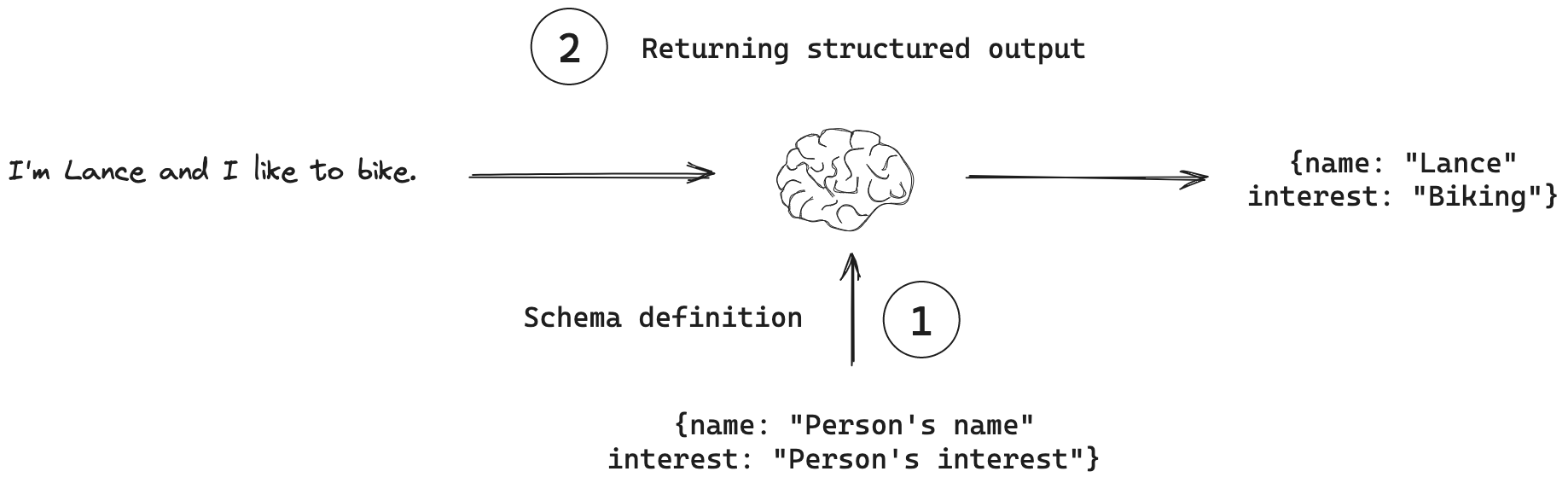
核心概念
(1) Schema定义: 输出结构以schema形式表示,可以通过多种方式定义。 (2) 返回结构化输出: 模型会收到此schema,并被指示返回符合该结构的输出。
推荐用法
此伪代码展示了使用结构化输出时推荐的工作流程。
LangChain 提供了一种方法,with_structured_output(),可自动完成将模式绑定到 模型 并解析输出的过程。
此辅助函数适用于所有支持结构化输出的模型提供商。
# Define schema
schema = {"foo": "bar"}
# Bind schema to model
model_with_structure = model.with_structured_output(schema)
# Invoke the model to produce structured output that matches the schema
structured_output = model_with_structure.invoke(user_input)
模式定义
核心概念是,模型响应的输出结构需要以某种方式被表示出来。 虽然你可以使用的对象类型取决于你正在处理的模型,但在Python中,通常允许或推荐用于结构化输出的对象类型有几种常见类型。
结构化输出最简单且最常见的格式是类似 JSON 的结构,在 Python 中可以表示为字典(dict)或列表(list)。 JSON 对象(在 Python 中即为字典)通常在工具需要原始、灵活且开销最小的结构化数据时直接使用。
{
  "answer": "The answer to the user's question",
  "followup_question": "A followup question the user could ask"
}
作为第二个例子,Pydantic 特别适用于定义结构化输出模式,因为它提供了类型提示和验证功能。 以下是一个 Pydantic 模式的示例:
from pydantic import BaseModel, Field
class ResponseFormatter(BaseModel):
    """Always use this tool to structure your response to the user."""
    answer: str = Field(description="The answer to the user's question")
    followup_question: str = Field(description="A followup question the user could ask")
返回结构化输出
定义好模式后,我们需要一种方法来指导模型使用它。 虽然一种方法是将此模式包含在提示中并礼貌地请求模型使用它,但这不被推荐。 还有几种更强大的方法,可以利用模型提供商API中的原生功能。
使用工具调用
许多 模型提供商支持 工具调用,这一概念在我们的 工具调用指南 中有更详细的讨论。
简而言之,工具调用涉及将一个工具绑定到模型上,当合适时,模型可以 决定 调用此工具,并确保其响应符合该工具的模式。
考虑到这一点,核心概念很简单:只需将我们的模式作为工具绑定到模型上即可!
以下是使用上面定义的 ResponseFormatter 模式的一个示例:
from langchain_openai import ChatOpenAI
model = ChatOpenAI(model="gpt-4o", temperature=0)
# Bind responseformatter schema as a tool to the model
model_with_tools = model.bind_tools([ResponseFormatter])
# Invoke the model
ai_msg = model_with_tools.invoke("What is the powerhouse of the cell?")
工具调用的参数已经作为字典提取出来。
此字典可以可选地解析为一个 Pydantic 对象,以匹配我们原始的 ResponseFormatter 模式。
# Get the tool call arguments
ai_msg.tool_calls[0]["args"]
{'answer': "The powerhouse of the cell is the mitochondrion. Mitochondria are organelles that generate most of the cell's supply of adenosine triphosphate (ATP), which is used as a source of chemical energy.",
 'followup_question': 'What is the function of ATP in the cell?'}
# Parse the dictionary into a pydantic object
pydantic_object = ResponseFormatter.model_validate(ai_msg.tool_calls[0]["args"])
JSON模式
除了工具调用之外,一些模型提供商还支持一种称为 JSON mode 的功能。
此功能支持以 JSON 模式定义输入,并强制模型生成符合要求的 JSON 输出。
你可以找到一份支持 JSON 模式的模型提供商表格 这里。
以下是使用 OpenAI 的 JSON 模式的一个示例:
from langchain_openai import ChatOpenAI
model = ChatOpenAI(model="gpt-4o").with_structured_output(method="json_mode")
ai_msg = model.invoke("Return a JSON object with key 'random_ints' and a value of 10 random ints in [0-99]")
ai_msg
{'random_ints': [45, 67, 12, 34, 89, 23, 78, 56, 90, 11]}
结构化输出方法
使用上述方法生成结构化输出时,会遇到一些挑战:
(1) 当使用工具调用时,需要将工具调用参数从字典解析回原始模式。
(2) 此外,当需要强制输出结构化结果时,模型需要被指示始终使用工具,这是一个特定于提供方的设置。
(3) 当使用 JSON 模式时,输出需要被解析为一个 JSON 对象。
考虑到这些挑战,LangChain 提供了一个辅助函数 (with_structured_output()) 来简化这个过程。
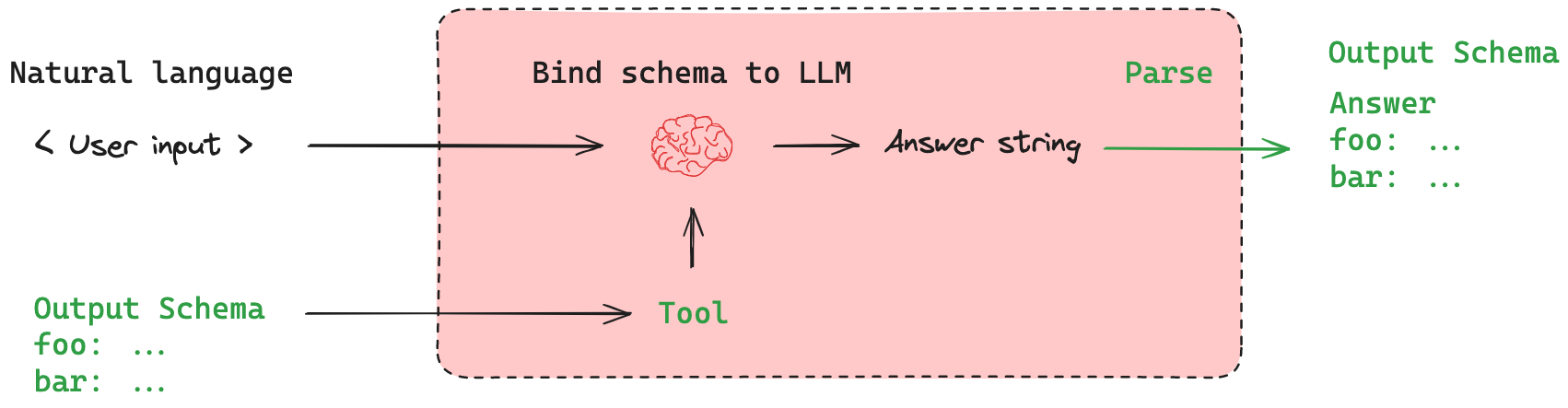
这既将模式绑定为模型的工具,又将输出解析为指定的输出模式。
# Bind the schema to the model
model_with_structure = model.with_structured_output(ResponseFormatter)
# Invoke the model
structured_output = model_with_structure.invoke("What is the powerhouse of the cell?")
# Get back the pydantic object
structured_output
ResponseFormatter(answer="The powerhouse of the cell is the mitochondrion. Mitochondria are organelles that generate most of the cell's supply of adenosine triphosphate (ATP), which is used as a source of chemical energy.", followup_question='What is the function of ATP in the cell?')
有关使用的更多详细信息,请参阅我们的 使用指南。