

Memgraph
Memgraph 是一个开源的图数据库,专为动态分析环境而优化,并与 Neo4j 兼容。为了查询数据库,Memgraph 使用 Cypher——这是目前应用最广泛、完全规范且开放的属性图数据库查询语言。
本笔记本将向您展示如何使用自然语言 查询 Memgraph,以及如何从非结构化数据中 构建知识图谱。
但在开始之前,请确保 完成所有设置。
设置
要完成本指南,您需要安装 Docker 和 Python 3.x。
要快速运行Memgraph Platform(Memgraph 数据库 + MAGE 库 + Memgraph Lab),首次操作时请执行以下步骤:
在 Linux/MacOS 上:
curl https://install.memgraph.com | sh
在 Windows 上:
iwr https://windows.memgraph.com | iex
两个命令都会运行一个脚本,该脚本会将 Docker Compose 文件下载到您的系统中,并在两个独立的容器中构建并启动 memgraph-mage 和 memgraph-lab Docker 服务。现在您已经成功运行了 Memgraph!有关安装过程的更多信息,请参阅 Memgraph 文档。
要使用 LangChain,请安装并导入所有必要的包。我们将使用包管理器 pip,以及 --user 标志,以确保正确的权限。如果您已安装 Python 3.4 或更高版本,pip 默认包含在内。您可以使用以下命令安装所有必需的包:
pip install langchain langchain-openai langchain-memgraph --user
你可以在这个笔记本中运行提供的代码块,或者使用一个单独的 Python 文件来实验 Memgraph 和 LangChain。
自然语言查询
Memgraph 与 LangChain 的集成包括自然语言查询功能。要使用它,首先进行所有必要的导入操作。我们将在代码中出现时逐一讨论它们。
首先,实例化 MemgraphGraph。此对象保存了与正在运行的 Memgraph 实例的连接。请确保正确设置所有环境变量。
import os

from langchain_core.prompts import PromptTemplate
from langchain_memgraph.chains.graph_qa import MemgraphQAChain
from langchain_memgraph.graphs.memgraph import Memgraph
from langchain_openai import ChatOpenAI

url = os.environ.get("MEMGRAPH_URI", "bolt://localhost:7687")
username = os.environ.get("MEMGRAPH_USERNAME", "")
password = os.environ.get("MEMGRAPH_PASSWORD", "")

graph = Memgraph(url=url, username=username, password=password, refresh_schema=False)
refresh_schema 的初始值被设置为 False,因为数据库中还没有数据,我们希望避免不必要的数据库调用。
填充数据库
要填充数据库,请首先确保它是空的。最有效的方法是切换到内存中的分析存储模式,删除图并返回到内存中的事务模式。了解更多关于 Memgraph 的 存储模式。
我们将添加到数据库中的数据是关于不同平台上各种类型视频游戏及其发行商的信息。
# Drop graph
graph.query("STORAGE MODE IN_MEMORY_ANALYTICAL")
graph.query("DROP GRAPH")
graph.query("STORAGE MODE IN_MEMORY_TRANSACTIONAL")

# Creating and executing the seeding query
query = """
    MERGE (g:Game {name: "Baldur's Gate 3"})
    WITH g, ["PlayStation 5", "Mac OS", "Windows", "Xbox Series X/S"] AS platforms,
            ["Adventure", "Role-Playing Game", "Strategy"] AS genres
    FOREACH (platform IN platforms |
        MERGE (p:Platform {name: platform})
        MERGE (g)-[:AVAILABLE_ON]->(p)
    )
    FOREACH (genre IN genres |
        MERGE (gn:Genre {name: genre})
        MERGE (g)-[:HAS_GENRE]->(gn)
    )
    MERGE (p:Publisher {name: "Larian Studios"})
    MERGE (g)-[:PUBLISHED_BY]->(p);
"""

graph.query(query)
[]
请注意,graph 对象包含 query 方法。该方法在 Memgraph 中执行查询,并且也被 MemgraphQAChain 用于查询数据库。
刷新图表模式
由于新数据是在 Memgraph 中创建的,因此需要刷新架构。生成的架构将由 MemgraphQAChain 使用,以指导 LLM 更好地生成 Cypher 查询。
graph.refresh_schema()
为了熟悉数据并验证更新后的图模式,您可以使用以下语句进行打印:
print(graph.get_schema)
Node labels and properties (name and type) are:
- labels: (:Platform)
  properties:
    - name: string
- labels: (:Genre)
  properties:
    - name: string
- labels: (:Game)
  properties:
    - name: string
- labels: (:Publisher)
  properties:
    - name: string

Nodes are connected with the following relationships:
(:Game)-[:HAS_GENRE]->(:Genre)
(:Game)-[:PUBLISHED_BY]->(:Publisher)
(:Game)-[:AVAILABLE_ON]->(:Platform)
查询数据库
要与OpenAI API进行交互,您必须将API密钥配置为环境变量。这确保了您的请求得到适当的授权。您可以在此处找到更多关于获取API密钥的信息 这里。要配置API密钥,您可以使用Python的os包:
os.environ["OPENAI_API_KEY"] = "your-key-here"
如果在 Jupyter 笔记本中运行代码,请运行上面的代码片段。
接下来,创建 MemgraphQAChain,它将在基于图数据的问答过程中被使用。将 temperature parameter 设置为零以确保答案可预测且一致。您可以将 verbose 参数设置为 True 以接收有关查询生成的更详细消息。
chain = MemgraphQAChain.from_llm(
    ChatOpenAI(temperature=0),
    graph=graph,
    model_name="gpt-4-turbo",
    allow_dangerous_requests=True,
)
现在你可以开始提问了!
response = chain.invoke("Which platforms is Baldur's Gate 3 available on?")
print(response["result"])
MATCH (:Game{name: "Baldur's Gate 3"})-[:AVAILABLE_ON]->(platform:Platform)
RETURN platform.name
Baldur's Gate 3 is available on PlayStation 5, Mac OS, Windows, and Xbox Series X/S.
response = chain.invoke("Is Baldur's Gate 3 available on Windows?")
print(response["result"])
MATCH (:Game{name: "Baldur's Gate 3"})-[:AVAILABLE_ON]->(:Platform{name: "Windows"})
RETURN "Yes"
Yes, Baldur's Gate 3 is available on Windows.
链修饰器
要修改链的行为并获取更多上下文或额外信息,您可以修改链的参数。
直接返回查询结果
return_direct 修饰符指定是返回执行的 Cypher 查询的直接结果,还是返回处理后的自然语言响应。
# Return the result of querying the graph directly
chain = MemgraphQAChain.from_llm(
    ChatOpenAI(temperature=0),
    graph=graph,
    return_direct=True,
    allow_dangerous_requests=True,
    model_name="gpt-4-turbo",
)

response = chain.invoke("Which studio published Baldur's Gate 3?")
print(response["result"])
MATCH (g:Game {name: "Baldur's Gate 3"})-[:PUBLISHED_BY]->(p:Publisher)
RETURN p.name
[{'p.name': 'Larian Studios'}]
返回查询中间步骤
return_intermediate_steps 链修饰符通过在返回的响应中包含查询的中间步骤,而不仅仅是初始查询结果,从而增强返回的响应。
# Return all the intermediate steps of query execution
chain = MemgraphQAChain.from_llm(
    ChatOpenAI(temperature=0),
    graph=graph,
    allow_dangerous_requests=True,
    return_intermediate_steps=True,
    model_name="gpt-4-turbo",
)

response = chain.invoke("Is Baldur's Gate 3 an Adventure game?")
print(f"Intermediate steps: {response['intermediate_steps']}")
print(f"Final response: {response['result']}")
MATCH (:Game {name: "Baldur's Gate 3"})-[:HAS_GENRE]->(:Genre {name: "Adventure"})
RETURN "Yes"
Intermediate steps: [{'query': 'MATCH (:Game {name: "Baldur\'s Gate 3"})-[:HAS_GENRE]->(:Genre {name: "Adventure"})\nRETURN "Yes"'}, {'context': [{'"Yes"': 'Yes'}]}]
Final response: Yes.
限制查询结果的数量
top_k 修饰符可用于限制查询结果的最大数量。
# Limit the maximum number of results returned by query
chain = MemgraphQAChain.from_llm(
    ChatOpenAI(temperature=0),
    graph=graph,
    top_k=2,
    allow_dangerous_requests=True,
    model_name="gpt-4-turbo",
)

response = chain.invoke("What genres are associated with Baldur's Gate 3?")
print(response["result"])
MATCH (:Game {name: "Baldur's Gate 3"})-[:HAS_GENRE]->(g:Genre)
RETURN g.name;
Adventure, Role-Playing Game
高级查询
随着解决方案的复杂性增加,你可能会遇到需要仔细处理的不同用例。确保应用程序的可扩展性对于保持用户流程顺畅无阻至关重要。
让我们再次实例化我们的链,并尝试提出一些用户可能会问的问题。
chain = MemgraphQAChain.from_llm(
    ChatOpenAI(temperature=0),
    graph=graph,
    model_name="gpt-4-turbo",
    allow_dangerous_requests=True,
)

response = chain.invoke("Is Baldur's Gate 3 available on PS5?")
print(response["result"])
MATCH (:Game{name: "Baldur's Gate 3"})-[:AVAILABLE_ON]->(:Platform{name: "PS5"})
RETURN "Yes"
I don't know the answer.
生成的 Cypher 查询看起来没问题,但我们没有收到任何信息作为响应。这说明了在使用大型语言模型(LLMs)时的一个常见挑战——用户提问的方式与数据存储方式之间的不匹配。在这种情况下,用户的感知与实际的数据存储方式之间的差异可能导致查询结果不准确。通过提示优化(prompt refinement),即对模型的提示进行精细化调整,使其更好地理解这些差异,是一种高效的解决方案,能够有效应对这一问题。通过提示优化,模型在生成精确且相关查询方面的能力得到提升,从而成功检索到所需的数据。
提示优化
为了解决这个问题,我们可以调整QA链的初始Cypher提示。这涉及到向LLM添加指导,说明用户如何引用特定平台,例如我们案例中的PS5。我们使用LangChain PromptTemplate来实现这一点,创建一个修改后的初始提示。然后将这个修改后的提示作为参数提供给我们的改进版MemgraphQAChain实例。
MEMGRAPH_GENERATION_TEMPLATE = """Your task is to directly translate natural language inquiry into precise and executable Cypher query for Memgraph database.
You will utilize a provided database schema to understand the structure, nodes and relationships within the Memgraph database.
Instructions:
- Use provided node and relationship labels and property names from the
schema which describes the database's structure. Upon receiving a user
question, synthesize the schema to craft a precise Cypher query that
directly corresponds to the user's intent.
- Generate valid executable Cypher queries on top of Memgraph database.
Any explanation, context, or additional information that is not a part
of the Cypher query syntax should be omitted entirely.
- Use Memgraph MAGE procedures instead of Neo4j APOC procedures.
- Do not include any explanations or apologies in your responses.
- Do not include any text except the generated Cypher statement.
- For queries that ask for information or functionalities outside the direct
generation of Cypher queries, use the Cypher query format to communicate
limitations or capabilities. For example: RETURN "I am designed to generate
Cypher queries based on the provided schema only."
Schema:
{schema}

With all the above information and instructions, generate Cypher query for the
user question.
If the user asks about PS5, Play Station 5 or PS 5, that is the platform called PlayStation 5.

The question is:
{question}"""

MEMGRAPH_GENERATION_PROMPT = PromptTemplate(
    input_variables=["schema", "question"], template=MEMGRAPH_GENERATION_TEMPLATE
)

chain = MemgraphQAChain.from_llm(
    ChatOpenAI(temperature=0),
    cypher_prompt=MEMGRAPH_GENERATION_PROMPT,
    graph=graph,
    model_name="gpt-4-turbo",
    allow_dangerous_requests=True,
)

response = chain.invoke("Is Baldur's Gate 3 available on PS5?")
print(response["result"])
MATCH (:Game{name: "Baldur's Gate 3"})-[:AVAILABLE_ON]->(:Platform{name: "PlayStation 5"})
RETURN "Yes"
Yes, Baldur's Gate 3 is available on PS5.
现在,使用包含平台命名指导的修订初始Cypher提示后,我们获得了与用户查询更紧密对齐的准确且相关的结果。
这种方法可以进一步改进你的问答链。你可以轻松地将额外的提示优化数据集成到你的链中,从而提升应用程序的整体用户体验。
构建知识图谱
将非结构化数据转换为结构化数据并不是一件容易或直接的任务。本指南将展示如何利用大型语言模型(LLMs)来帮助我们完成这一任务,并介绍如何在Memgraph中构建知识图谱。创建知识图谱后,您可以将其用于您的GraphRAG应用程序。
从文本构建知识图谱的步骤是:
- 从文本中提取结构化信息:大型语言模型(LLM)用于以节点和关系的形式从文本中提取结构化的图信息。
- 存储到 Memgraph:将提取的结构化图信息存储到 Memgraph。
从文本中提取结构化信息
除了在设置部分的所有导入之外,还导入LLMGraphTransformer和Document,它们将用于从文本中提取结构化信息。
from langchain_core.documents import Document
from langchain_experimental.graph_transformers import LLMGraphTransformer
以下是关于查尔斯·达尔文的示例文本(来源),将从中构建知识图谱。
text = """
    Charles Robert Darwin was an English naturalist, geologist, and biologist,
    widely known for his contributions to evolutionary biology. His proposition that
    all species of life have descended from a common ancestor is now generally
    accepted and considered a fundamental scientific concept. In a joint
    publication with Alfred Russel Wallace, he introduced his scientific theory that
    this branching pattern of evolution resulted from a process he called natural
    selection, in which the struggle for existence has a similar effect to the
    artificial selection involved in selective breeding. Darwin has been
    described as one of the most influential figures in human history and was
    honoured by burial in Westminster Abbey.
"""
下一步是从所需的大型语言模型(LLM)初始化 LLMGraphTransformer,并将文档转换为图结构。
llm = ChatOpenAI(temperature=0, model_name="gpt-4-turbo")
llm_transformer = LLMGraphTransformer(llm=llm)
documents = [Document(page_content=text)]
graph_documents = llm_transformer.convert_to_graph_documents(documents)
在内部,大型语言模型(LLM)从文本中提取重要实体,并将它们作为节点和关系的列表返回。以下是它的样子:
print(graph_documents)
[GraphDocument(nodes=[Node(id='Charles Robert Darwin', type='Person', properties={}), Node(id='English', type='Nationality', properties={}), Node(id='Naturalist', type='Profession', properties={}), Node(id='Geologist', type='Profession', properties={}), Node(id='Biologist', type='Profession', properties={}), Node(id='Evolutionary Biology', type='Field', properties={}), Node(id='Common Ancestor', type='Concept', properties={}), Node(id='Scientific Concept', type='Concept', properties={}), Node(id='Alfred Russel Wallace', type='Person', properties={}), Node(id='Natural Selection', type='Concept', properties={}), Node(id='Selective Breeding', type='Concept', properties={}), Node(id='Westminster Abbey', type='Location', properties={})], relationships=[Relationship(source=Node(id='Charles Robert Darwin', type='Person', properties={}), target=Node(id='English', type='Nationality', properties={}), type='NATIONALITY', properties={}), Relationship(source=Node(id='Charles Robert Darwin', type='Person', properties={}), target=Node(id='Naturalist', type='Profession', properties={}), type='PROFESSION', properties={}), Relationship(source=Node(id='Charles Robert Darwin', type='Person', properties={}), target=Node(id='Geologist', type='Profession', properties={}), type='PROFESSION', properties={}), Relationship(source=Node(id='Charles Robert Darwin', type='Person', properties={}), target=Node(id='Biologist', type='Profession', properties={}), type='PROFESSION', properties={}), Relationship(source=Node(id='Charles Robert Darwin', type='Person', properties={}), target=Node(id='Evolutionary Biology', type='Field', properties={}), type='CONTRIBUTION', properties={}), Relationship(source=Node(id='Common Ancestor', type='Concept', properties={}), target=Node(id='Scientific Concept', type='Concept', properties={}), type='BASIS', properties={}), Relationship(source=Node(id='Charles Robert Darwin', type='Person', properties={}), target=Node(id='Alfred Russel Wallace', type='Person', properties={}), type='COLLABORATION', properties={}), Relationship(source=Node(id='Natural Selection', type='Concept', properties={}), target=Node(id='Selective Breeding', type='Concept', properties={}), type='COMPARISON', properties={}), Relationship(source=Node(id='Charles Robert Darwin', type='Person', properties={}), target=Node(id='Westminster Abbey', type='Location', properties={}), type='BURIAL', properties={})], source=Document(metadata={}, page_content='\n Charles Robert Darwin was an English naturalist, geologist, and biologist,\n widely known for his contributions to evolutionary biology. His proposition that\n all species of life have descended from a common ancestor is now generally\n accepted and considered a fundamental scientific concept. In a joint\n publication with Alfred Russel Wallace, he introduced his scientific theory that\n this branching pattern of evolution resulted from a process he called natural\n selection, in which the struggle for existence has a similar effect to the\n artificial selection involved in selective breeding. Darwin has been\n described as one of the most influential figures in human history and was\n honoured by burial in Westminster Abbey.\n'))]
存储到 Memgraph
一旦你准备好数据,格式为GraphDocument,即节点和关系,你可以使用add_graph_documents方法将其导入Memgraph。该方法将graph_documents列表转换为需要在Memgraph中执行的适当Cypher查询。完成之后,知识图谱存储在Memgraph中。
# Empty the database
graph.query("STORAGE MODE IN_MEMORY_ANALYTICAL")
graph.query("DROP GRAPH")
graph.query("STORAGE MODE IN_MEMORY_TRANSACTIONAL")

# Create KG
graph.add_graph_documents(graph_documents)
这是在 Memgraph Lab 中的图表(检查 localhost:3000):
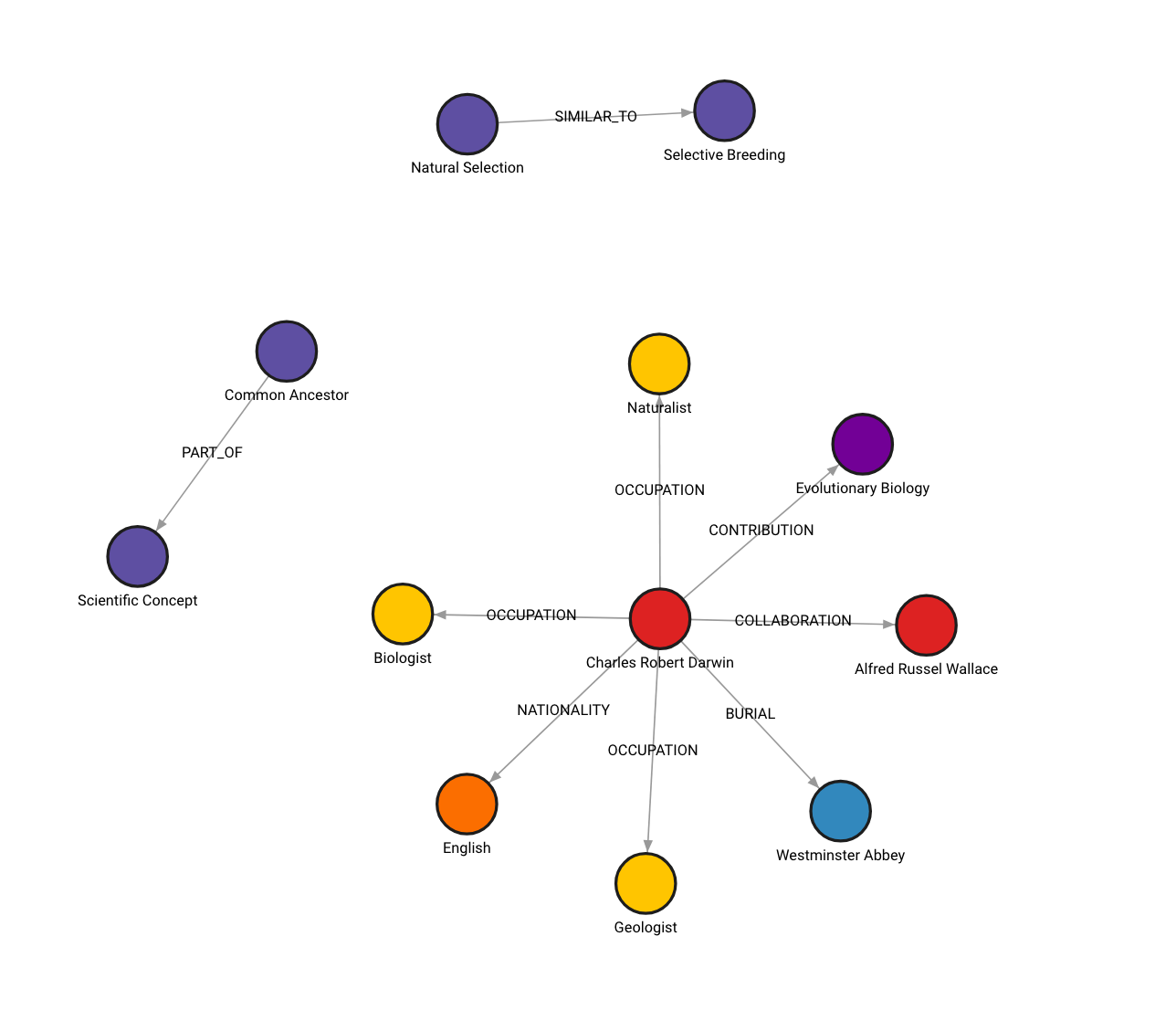
如果你尝试后得到了不同的图表,这是预期的行为。图的构建过程是非确定性的,因为用于从非结构化数据中生成节点和关系的语言模型(LLM)本身是非确定性的。
附加选项
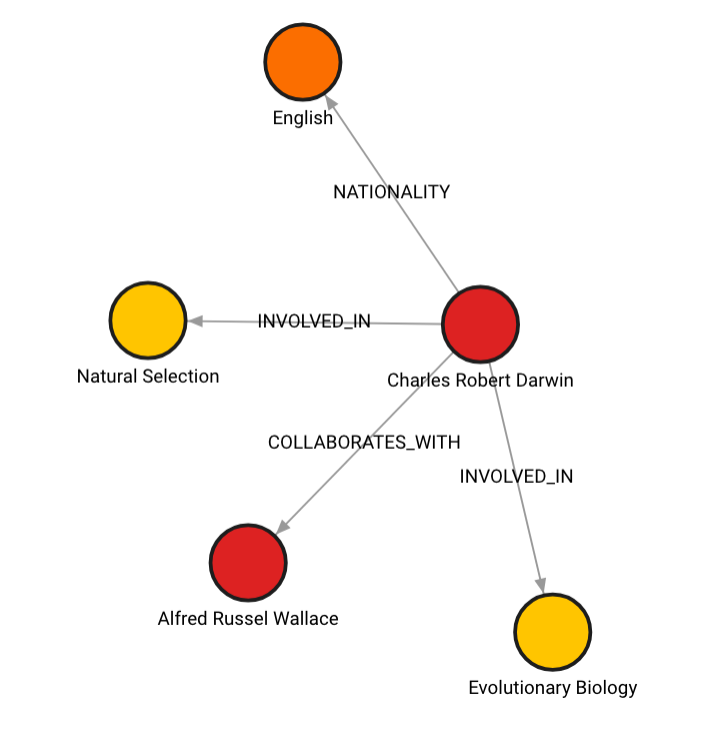
此外,您还可以根据需求灵活定义特定类型的节点和关系以进行提取。
llm_transformer_filtered = LLMGraphTransformer(
    llm=llm,
    allowed_nodes=["Person", "Nationality", "Concept"],
    allowed_relationships=["NATIONALITY", "INVOLVED_IN", "COLLABORATES_WITH"],
)
graph_documents_filtered = llm_transformer_filtered.convert_to_graph_documents(
    documents
)

print(f"Nodes:{graph_documents_filtered[0].nodes}")
print(f"Relationships:{graph_documents_filtered[0].relationships}")
Nodes:[Node(id='Charles Robert Darwin', type='Person', properties={}), Node(id='English', type='Nationality', properties={}), Node(id='Evolutionary Biology', type='Concept', properties={}), Node(id='Natural Selection', type='Concept', properties={}), Node(id='Alfred Russel Wallace', type='Person', properties={})]
Relationships:[Relationship(source=Node(id='Charles Robert Darwin', type='Person', properties={}), target=Node(id='English', type='Nationality', properties={}), type='NATIONALITY', properties={}), Relationship(source=Node(id='Charles Robert Darwin', type='Person', properties={}), target=Node(id='Evolutionary Biology', type='Concept', properties={}), type='INVOLVED_IN', properties={}), Relationship(source=Node(id='Charles Robert Darwin', type='Person', properties={}), target=Node(id='Natural Selection', type='Concept', properties={}), type='INVOLVED_IN', properties={}), Relationship(source=Node(id='Charles Robert Darwin', type='Person', properties={}), target=Node(id='Alfred Russel Wallace', type='Person', properties={}), type='COLLABORATES_WITH', properties={})]
在这种情况下,图表会是这样的:
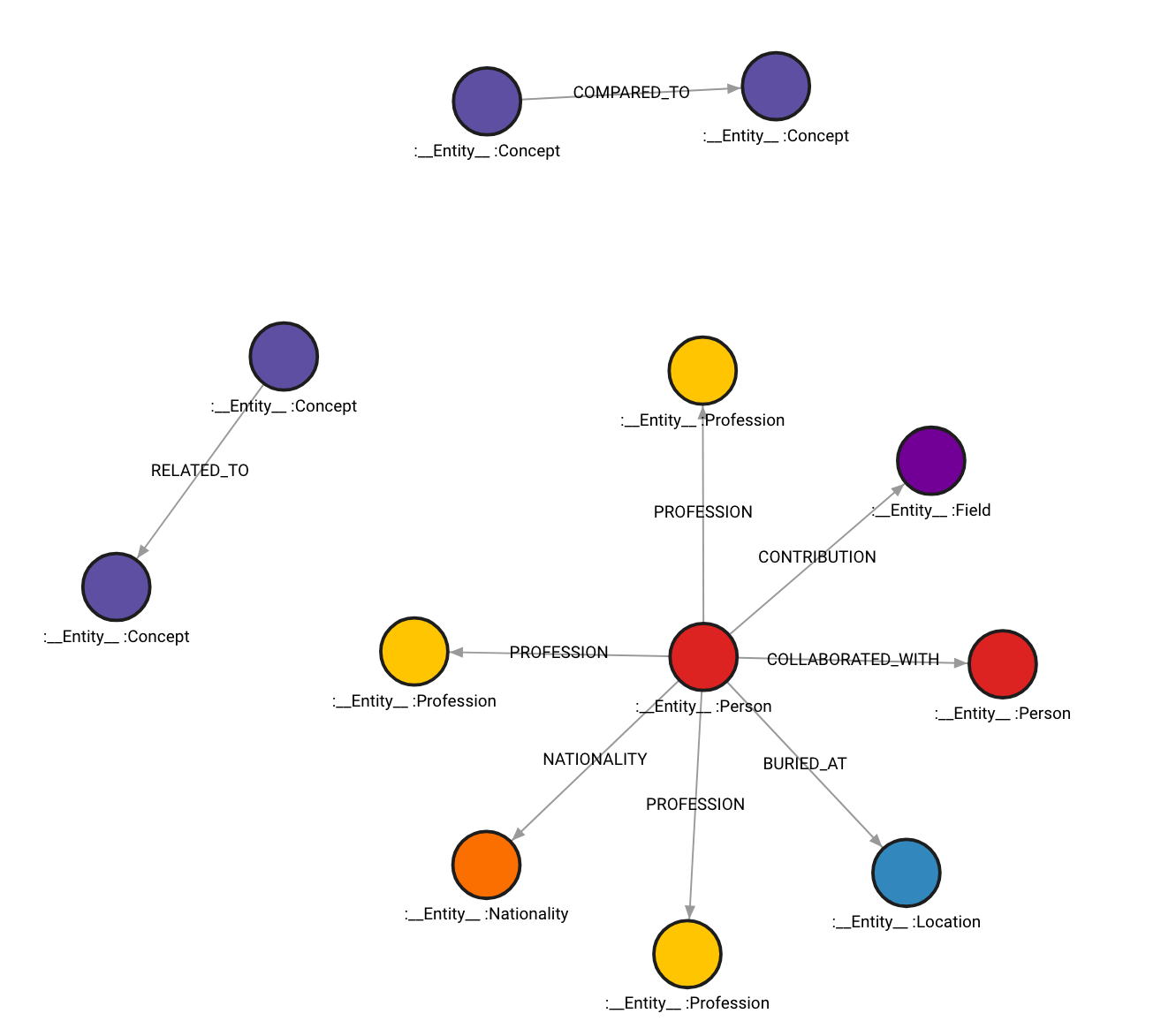
您的图也可以在所有节点上具有 __Entity__ 个标签,这些标签将被索引以实现更快的检索。
# Drop graph
graph.query("STORAGE MODE IN_MEMORY_ANALYTICAL")
graph.query("DROP GRAPH")
graph.query("STORAGE MODE IN_MEMORY_TRANSACTIONAL")

# Store to Memgraph with Entity label
graph.add_graph_documents(graph_documents, baseEntityLabel=True)
以下是图表的样式:
还可以选择在图中包含所获取信息的来源。要做到这一点,将 include_source 设置为 True,然后源文档会被存储,并且通过 MENTIONS 关系将其链接到图中的节点。
# Drop graph
graph.query("STORAGE MODE IN_MEMORY_ANALYTICAL")
graph.query("DROP GRAPH")
graph.query("STORAGE MODE IN_MEMORY_TRANSACTIONAL")

# Store to Memgraph with source included
graph.add_graph_documents(graph_documents, include_source=True)
构建的图将如下所示:
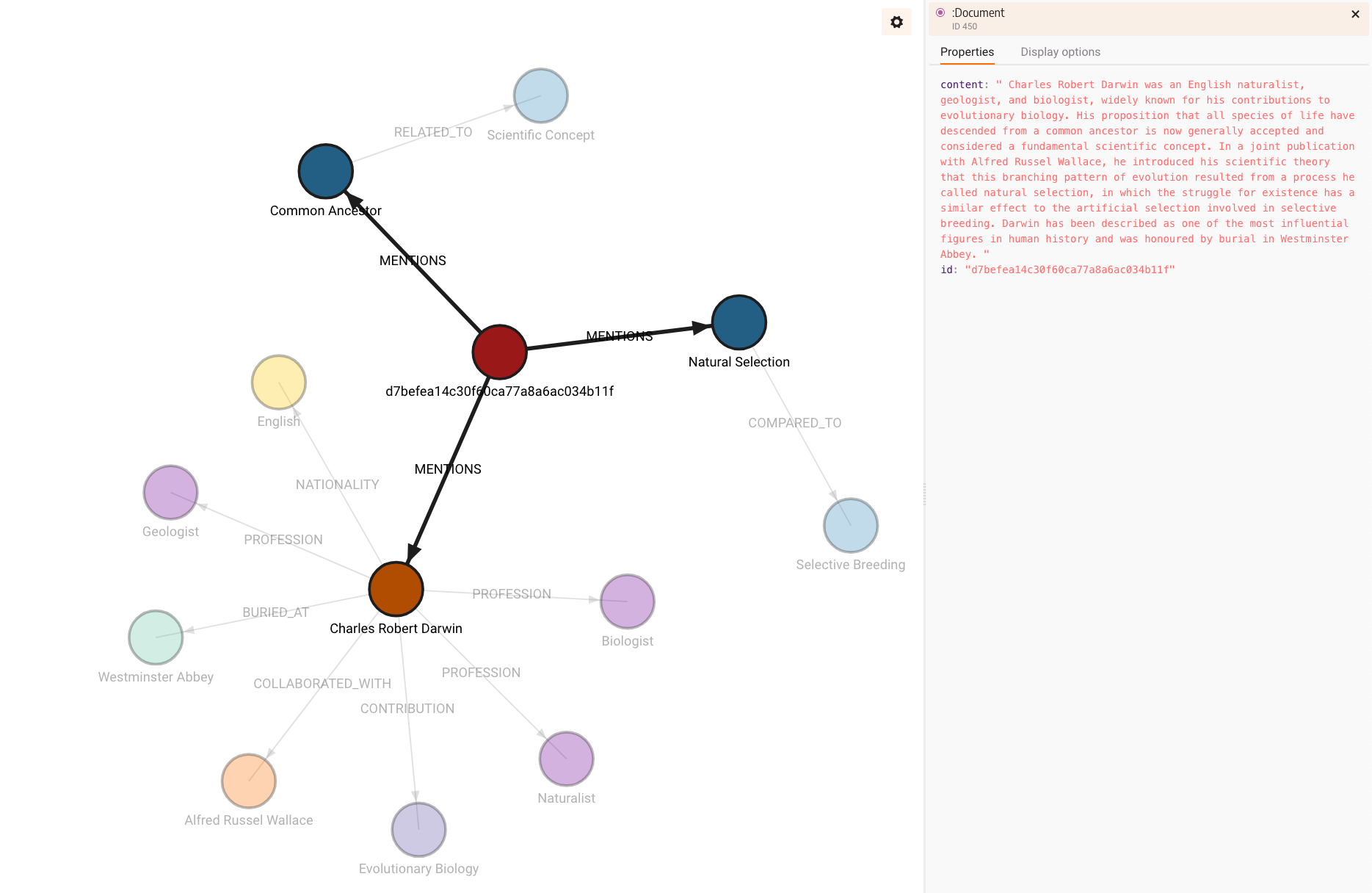
请注意,源内容被存储,并且由于文档没有 id 属性,因此生成了 id 属性。
您可以同时拥有 __Entity__ 标签和文档源。不过,请注意,两者都会占用内存,尤其是源内容,因为长字符串的内容会占用更多内存。
最终,你可以查询知识图谱,如前所述的章节中所解释的那样:
chain = MemgraphQAChain.from_llm(
    ChatOpenAI(temperature=0),
    graph=graph,
    model_name="gpt-4-turbo",
    allow_dangerous_requests=True,
)
print(chain.invoke("Who Charles Robert Darwin collaborated with?")["result"])
MATCH (:Person {id: "Charles Robert Darwin"})-[:COLLABORATION]->(collaborator)
RETURN collaborator;
Alfred Russel Wallace